|
Ragtime Music in Canada
Chapter 5: The Ragtime Revival in Canada
By Ted Tjaden [return to Table of Contents] [go to Chapter 6] Canada
played an important role with the revival of
ragtime in the 1960's primarily through the
efforts of people like Ragtime Bob Darch (resident
in Toronto as a performer at Club 76), John Arpin,
and The Canadian Ragtime Society. At around the
same time, with the publication of They All
Played Ragtime (Blesh and Janis 1966),
ragtime music was well on its way to not only
being revived but thoroughly reinvigorated (for
more on ragtime revival in the United States, see
John Edward Hasse, "Rudi Blesh and the Ragtime
Revivalists" (Hasse 1985:178) and Bill
Edwards, "An
Essay on the Core of the First Ragtime Revival").
For many baby boomers, however, myself included,
ragtime awareness came later with the ragtime
soundtrack to the movie The
Sting in 1973. In this
section, I briefly review the ragtime revival in
Canada starting first with the important role
played by The Ragtime Society and its newsletter,
The Ragtimer (1962-1985), followed by
brief profiles of a number of influential Canadian
(and American) ragtime enthusiasts who have played
important roles with the revival of ragtime in
Canada.
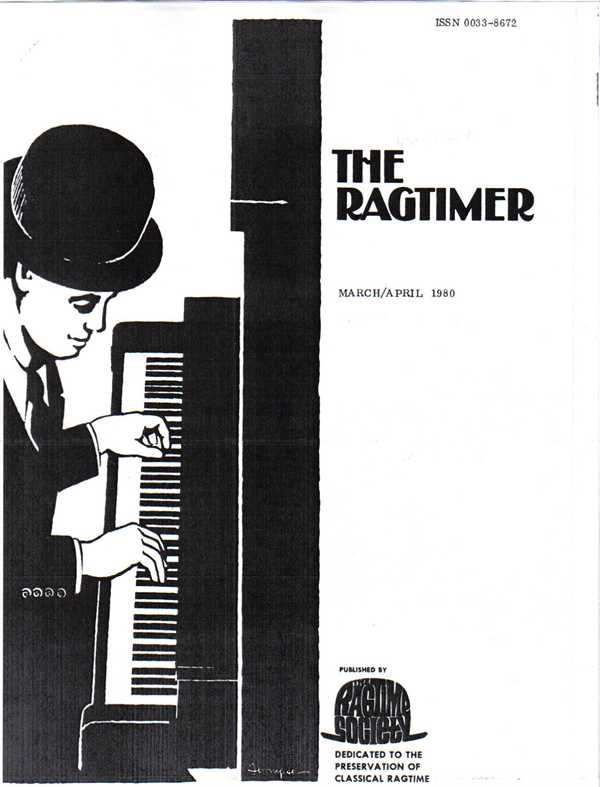
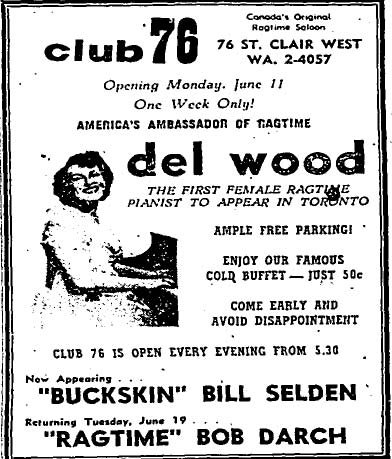
a) The Ragtime Society and The Ragtimer Ragtime music in Canada never really died out among its main enthusiasts and it could be argued that Canada played an integral role in reviving ragtime music in the late 1950s. At that time (in 1959), Ragtime Bob Darch arrived in Toronto with his Cornish Upright Grand Five Pedal Saloon Piano and was a regular performer at Club 76 on St Clair St West in Toronto, Ontario. Darch was instrumental in raising funds to arrange for Joseph Lamb to come to Toronto that year for a tribute and a performance: The October 3, 1959, edition of the Globe & Mail (page 16) describes Darch's fundraising to bring Joseph Lamb and his wife to Toronto, mentioning a promise of Club 76 to pay into a United Appeal Fund $2 for every $1 collected. Important ragtime performers, including Eubie Blake, Max Morath and Johhny Maddox, all performed at some point at Club 76. An ad for Club 76 in the January 30, 1961, Globe & Mail advertised that Max Morath was now in his 3rd week at the club and that Johhny (Crazy Otto) Maddox would be coming soon! It is in this context that the Ragtime Society had its first formal meeting on January 19, 1962, in Toronto, Ontario, among a number of steadfast ragtime enthusiasts (note: the information in this section on the history of The Ragtime Society comes mainly from the March-April-May-June 1982 edition of The Ragtimer). The Ragtime Society took as its motto the phrase "Dedicated to the Preservation of Classical Ragtime." The Ragtime Society was only later incorporated June 30, 1970, as a non profit corporation in Ontario with its first directors being Jack Aldred, Anne Arpin, John Arpin, Jean Cuff, Jack Cuff, John Fairhead, Idamay MacInnes and Baron McCormick. Its first officers were John Arpin, President, John Fairhead, Secretary and Idamay MacInnes, Treasurer. The Society's first newsletter was published in February 1962 and its first sentence announced: "It is very gratifying to find so many Canadians and Americans interested in Classic Ragtime."
On May 4, 1962, a memorial concert was organized for Joseph Lamb at Massey Hall in Toronto with Robert Darch and the Toronto Symphony Orchestra, with more than 2,500 persons in attendance. Some of
the early activities of the Society included
sourcing hard to find rags, producing a number of
ragtime records under the Scroll label and
organizing annual "bashes" at which members and
invited guests entertained with ragtime music. In
1964, the Society arranged for a limited edition
reprinting of Scott Joplin's ragtime opera Treemonisha.
Also in 1964 was the Society's first of many
annual bashes. The bashes were energetic affairs
with numerous performers. The November/December
1976 edition of The Ragtimer, for example,
lists only some of the performers as including
William Bolcolm and Joan Morris, Terry Waldo, Tex
Wyndham, Eubie Blake (age 93), John Arpin, Lou
Hooper, and The Canadian Brass, with Amelia Lamb
and Joe Lamb Jr as guests. The program notes
indicate that performances, of which there were
over 45, went from 3 pm to past midnight. b) John Arpin John Arpin (born December 3, 1936, died November 8, 2007) was one of Canada's most renown pianists with a constant repertoire of classic ragtime piano in addition to a variety of other musical styles. From his official online biography (an archived version of which is available here), we learn that he was born in Port McNicoll, Ontario, and graduated from the Royal Conservatory of Music at the tender age of 16. Although Arpin then attended the Faculty of Music, University of Toronto, he abandoned the academic experience in favour of performing at various local establishments and conducting a choir. According to his biography, Arpin "could also be found on the concert stage accompanying an opera singer, or performing turn-of-the-century music by Canadian composers on radio." He has recorded numerous CDs, including a number of ragtime CDs. One of his more recent recordings is the wonderful "Blue Gardenia" featuring the Latin American music of Hal Isbitz (highly recommended). Arpin was awarded the Scott Joplin Award in 1998 by the Scott Joplin Foundation in Sedalia, Missouri. Attending one of Arpin's concerts was a pleasure; he usually started with a number of rags (often with Peacherine Rag by Scott Joplin) and recounted numerous stories of his friendship with Eubie Blake. At the last concert I saw in Toronto a few years ago, one of his encores included a ragtime song, When Ragtime Rosie Ragged the Rosary. Known as the "Chopin of Ragtime," Arpin was a versatile pianist, comfortable in any number of genres. He was quoted in 1966 as saying that "I once figured out I know 2,000 tunes," at a time when he worked two gigs: performing ragtime at at the Last Chance Saloon in Toronto until 8:30, and then moving to Mister Tony's in Yorkville where he performed show tunes and classical piano (Scott:1966). He is one
of the few Canadian ragtimers to have an entry in
the The
Encyclopedia of Music in Canada (see
his entry here).
His
official website has been de-activated but can
still be viewed here at the Internet
Archive. John
Arpin passed away on Thursday, November 8, 2007. His wife kept a blog here describing his battle with cancer and many details about his (and their) personal life. York
University continues to digitize Arpin's
personal collection of sheet donated by his
wife (currently over 8,800 titles). c) Mimi Blais Mimi is a pianist from Montreal, Quebec, whose repertoire is heavily infused with ragtime music. She is a regular performer at various ragtime festivals and concerts and has recorded a number of CDs, including a CD of the rags of Jéan-Baptiste LaFrenière (1874-1912), himself a pianist and composer from Quebec who composed a number of interesting rags and waltzes that are featured in my separate essay on Jéan-Baptiste LaFrenière and ragtime in Québec. The
Encyclopedia of Music in Canada has a
detailed entry for Mimi here. d Eubie Blake
(February 7, 1887 – February 12, 1983)
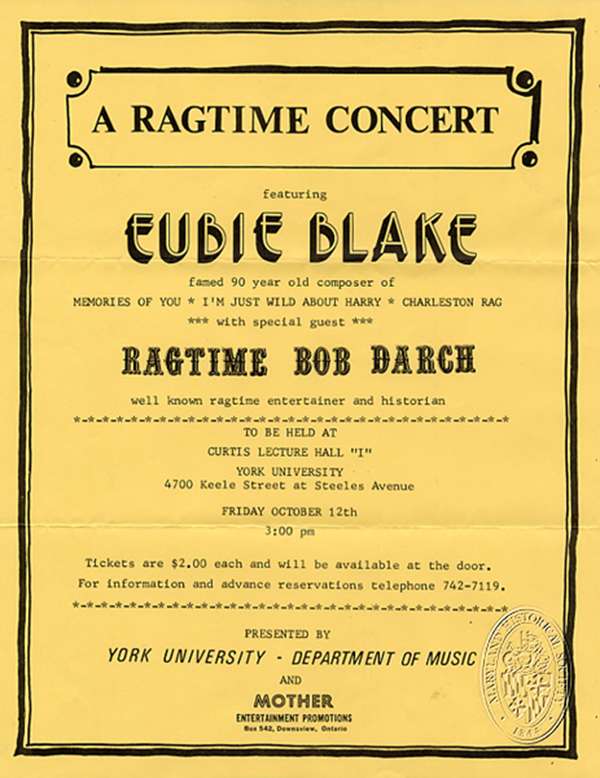
"Ragtime Bob" Darch would qualify as an honorary Canadian due to his important presence in Toronto at Club 76 during the early 1960's and the role that he played in keeping ragtime alive ("Ragtime is dead? Hell, it ain't even sick!"). He is credited with encouraging Eubie Blake to come out of retirement and was instrumental in organizing a trip by Joseph Lamb to Toronto in 1959 for one of Lamb's very few public performances. Darch was known for promoting ragtime through his playing in saloons and any venue where he could play ragtime.
Known for his "Five Pedal Cornish Upright Saloon Grand Piano," Darch was not only a ragtime player but also a composer and researcher. Here is a picture of Darch standing next to his famous piano with a note on the photo from Eubie Blake saying "Ragtime Bob Darch 1959 He's one great Ragtime Pianist of his time. E.B."
Well-known ragtimer, Ian Whitcomb, has a nice online article entitled "Bob Darch: My Adventures with the Great Man." Darch
passed away on October 20, 2002, in Springfield,
Missouri. The Rose Leaf Ragtime Club has a nice
online profile on this important ragtimer
(archived version here). f) Lou Hooper
Lou Hooper was born in North Buxton, Ontario, on May 18, 1884, and died in Charlottetown, PEI, on September 17, 1977. Although Hooper spent much of his musical career in the United States, he never forgot his Canadian roots. He studied music in Detroit and also formed a small orchestra and played for various local dances. He served in a US army concert band during World War I, after which he lived in Harlem, New York, from 1921 to 1927 where he continued to study music and play with various well known jazz bands, backing a number of famous vocalists, including Ethel Waters, Ma Rainey, and Mamie Smith. He accompanied Paul Robeson on tour in 1926 and was a member of Lew Leslie's Blackbirds. Apparently, Hooper composed a number of ragtime compositions, including The Cakewalk, Black Cat Blues (1925), South Sea Strut and Uncle Remus Stomp, but I have not yet been able to locate copies of these pieces. Hooper returned to Canada in the 1930's and ended up in Montreal where he played in various bands and taught piano, with one of his students being Oscar Peterson. The Music
Archives at the National Library of Canada has
acquired archival material on Lou Hooper (obtained
from his wife in 1980 (click here for more
information) (archived version). The
September/October 1975 edition of The Ragtimer
provides a brief article (and photo) of Austin
Kitchen and describes him as the composer of The
Mississauga Rag. He is also briefly
mentioned in the "ragtime"
entry to the The
Canadian Encyclopedia as being from
Mississauga, Ontario. The article in The
Ragtimer mentions that he was very proud of
the copy of the 1899 Charleston Rag by
Eubie Blake that Blake personally sent him. The
article also mentions that Kitchen played piano at
Casa Loma in Toronto for 4 years and played with King
Ganam, Tommy
Hunter, and Gordie
Tapp and that he also used to write reels
and jigs on the fiddle. I identified an additional
piece composed by Kitchen, being Once Upon a
Time (Mississauga, ON: Eldorado Music
Publications, 1975), but it is not clear whether
or not this is a ragtime piano composition. h) David Lee (Born: Hamilton, ON: 10 November 1934 – 22 January 2019)
David Lee
is mentioned in the "ragtime"
entry to The
Canadian Encyclopedia as being a
lawyer from Dundas,
Ontario, who has composed a number of rags
published by his own company, Dun-Val Music. I
have been able to identify 11 rags composed by
Lee, listed below, but they
have been difficult to source (with the only
source I have found so far being a folio of David
Lee rags held by the Hamilton Public Library
in Ontario, which I recently borrowed) (or you can
purchase them directly from the composer's
family). A reader of this site recently sent an email letting me know that the liner notes to David Lee's ragtime LP called "Original Rags" provided more information about the composer, containing the following comments by David Lee on his compositions:
The liner
notes by Ross Wilby (from November 1976) also
indicate that David Lee was married with four kids
and that he and his wife, Ruth, both obtained
music degrees. A
newspaper story here from 2015 describes
David Lee's life, including his miniature train
collection. David Lee
passed away on January 22, 2019.
In the next chapter, I have included .mp3 recordings of selected Canadian ragtime music. |
||||||||||||||||||||||||||||||||||
|
This site created by Ted Tjaden. Page last updated: January 2025.
|